We’re So Smart It’s Terrifying

Awful

Awful


Two years ago we wrote a post on the foolishness of getting caught up in topical and exciting initial public offerings. And this was back when Facebook was still privately held.

For the unsophisticated among you, yet another piece of knowledge that’s so obvious it’s easy to miss:

Your bank account understands only numbers. It doesn’t care about social buzz, popularity, trendiness, your Pinterest board, what Jay-Z has to say about diversification, or what your friends are doing (especially what your friends are doing.) That bank account is antiseptic and uninterested (disinterested, really) in your workaday concerns. It only sits there. It doesn’t even necessarily want to grow. Great if it does grow, but getting it to do so is your problem. Your financial balances don’t want to grow because they don’t want to do anything. They have no capacity for desire, nor any other emotion. And with respect to money, neither should you.

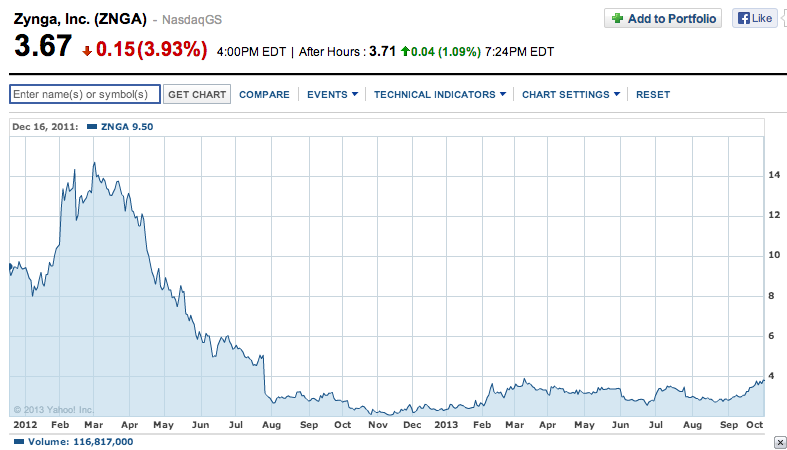
Seriously, what is the point of snapping up Zynga stock the moment it goes on sale? For a lot of people, it goes no deeper than “Here’s this product/service that I use, and now shares of the company that makes it are available for purchase. Therefore, I can take both figurative and literal ownership of it, and derive validation that way.” If it’s important for you to self-identify as an avant-garde shareholder, in tune with the New Economy, Business 2.0, stop reading. You’re going to hurt yourself.

Folks, we’re in this for one thing only. MONEY. It’s all that matters, at least for our purposes. Otherwise go find a personal fulfillment blog or one of those unreadable debt blogs instead. Here’s one to get you started.

Back to the summer of 2011. It was a simpler time. Prince William and the incipient Duchess of Cambridge had just moved out of their parents’ places and in together. South Sudan didn’t yet exist as an independent nation. Amy Winehouse still had a pulse. And Crumbs Bakery went public.

Our parents’ generation had little trouble discerning between Things of Importance (work, responsibility, knowing how to fix a carburetor) and Trivialities (self-expression, keeping your friends apprised of your hour-to-hour activities.) Cupcakes were on the latter list, and near the bottom.

We maintained that a business predicated on the creation and delivery of cupcakes was something better suited for prepubescent neighborhood girls than for a NASDAQ-listed company. Or for a NASDAQ Capital Market-listed company. (That’s the real NASDAQ’s developmentally delayed cousin.)

Crumbs went in the toilet, and quickly. It took 2 months to lose half its value, which it never regained. In fact, it took another 6 months to lose half its value again. It’s since lost yet another half of its value and then some, making Crumbs stock a Zeno’s Tortoise of sorts.

Why was this an awful investment? Well, we already told you way back then, but if you didn’t click the link:

  • The company expanded way too quickly. 
  • It doesn’t take a tenured college professor to determine that cupcake demand is pretty elastic. The lower your income falls, which it likely has if you’ve lived in the United States since Crumbs’ inception, the smaller the ratio of it you’re going to spend on sugary treats.
  • Barriers to entry? Any idiot with a pan and some non-stick spray can bake muffins.
  • You’re probably fat. Eat some celery instead.

Our recommendation instead was to invest in Crumbs’ antithesis. A company beyond uncool. There isn’t even any room for this company on the hipness continuum. You can’t savor their products, or even touch most of them. McKesson distributes wholesale drugs and medical supplies. And it sells clinical software to hospitals, too. Is that getting you excited? If not you, then how about the lifestyle editor at The New York Times Magazine? Did Sex & The City ever do an episode about workflow management for osteopaths?

McKesson is up 38% in the last year and a half, or about 12,800 basis points more than Crumbs. If we told you one of these companies would be bankrupt in a year – McKesson, which pulls in $122 billion annually; or Crumbs and its $14 million market capitalization, with operating expenses that eat up its gross profit and then some every quarter – which would you pick?

People like to think they want more money than they currently have. But in practice, lots don’t. The ones who dabble in investing, more properly dubbed speculating in their cases, mostly have motivations other than that of increasing their net worth. We aren’t completely sure what those motivations are, and we don’t care. The road to building wealth doesn’t have to be glamorous to be effective, and probably shouldn’t. If everyone’s talking about an investment, it doesn’t mean it’s worth investing in. It doesn’t necessarily mean that it’s not worth investing in, either, but maybe you should use measuring sticks other than public natter.

The Control Your Cash Open-Book Quiz, Part II

Fun with homonyms

Fun with homonyms


Today, the 2nd installment in the Control Your Cash Open-Book Quiz. Yes, it’s several weeks late. That’s called sheer procrastination creating anticipation. Anyhow, the Open-Book Quiz works like so: we give you a scenario and a wad of theoretical cash, and you decide what to do with both. See the previous post in the series if this makes no sense. In fact, it almost certainly won’t.


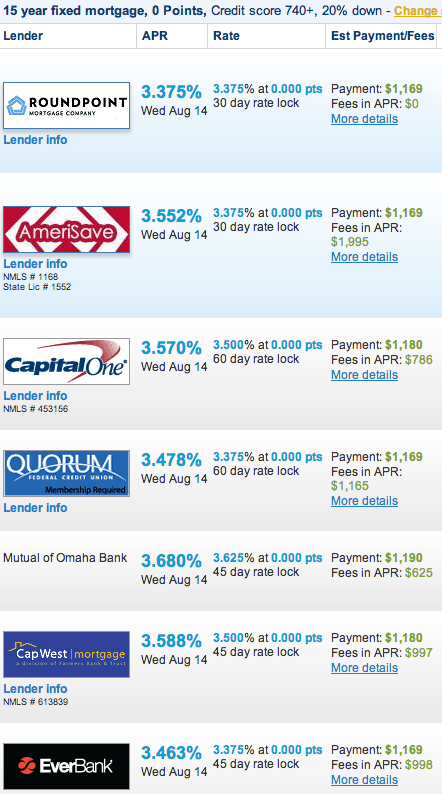
You’ve found a house being sold short, and listed at $100,000. A tenant is already renting it, and is on a lease for the next year at $1000/month.  Similar nearby houses sell for $100,000-$125,000. With 20% down, you can get a 3½% fixed mortgage.

Is this a good deal, or not?

Before you sign a contract, or commit the equally meaningful step of walking away from signing a contract, make sure you know exactly what you’re getting into. One way to do that is to always start with an investment policy. You can’t decide what to invest in until you know what outcome you’re looking for, and how much risk and volatility you’re willing to tolerate to get it.

Here we have a cheap house and cheap money, indicative of the historical double nadir we’re experiencing in the prices of both real estate and its financing. Even though today’s post is only a fictional exercise, the truth remains: Never has there been a better time to buy a house, especially as an investment. We’ve been saying this for years, but market forces (and governmental perversion of them) haven’t yet changed enough for us to recalibrate our opinion.

The 3rd selling point here is the immediate tenant. One who’s already on a lease is a perfect illustration of how vital cash flow can be to an investment that looks good on paper but might not work in practice. No matter how attractive an investment might be, you can’t build wealth entirely on speculation. You need monthly checks. Preferably sooner than later. That empty plot of land on the edge of a burgeoning town might octuple in value over the next 18 months. Or it might just sit there without anyone ever making an offer. Ceteris paribus, buy the property that promises you income while you’re waiting for effortless riches down the road.

To determine the value of this investment in comparison to others into which you might commit a comparable amount of money, you need to get to a common rate of return.  Apples vs. apples and all that. That means it’s time to do a little math. In these examples, we’re going to calculate the value of the property based on its cash flow only.

Here are the terms and formulas you need to know:

Potential Rental Income. The shekels generated by the property in a theoretical, fully rented world. A world where you never have a vacant day, and in which every outgoing tenant is replaced by a fresh tenant later that evening. This world can only be approximated, never reached.

Vacancy Rate. The number of empty, unrented units in the property, divided by the total number of units. This only applies to properties with multiple units, of course. A 10-unit apartment complex with 8 rented units has a 20% vacancy rate. A 1-unit house has a vacancy rate of either 0 or 100%.

Gross Rental Income. Potential rental income x (1 – the vacancy rate.)  Intuitively, this should make sense. Call (1 – the vacancy rate) the occupancy rate if you have trouble with abstractions.

Operating Expenses. All the costs of running the property excluding the loan payment.

Net Operating Income. Gross Rental Income – Operating Expenses.

(It’s obvious that those are minus signs and not em dashes, right? Oh God it isn’t, is it? Start again from the top.)

Cash Flow (before taxes and depreciation.) Net Operating Income – loan payments.

That’s the big one, the one that marks the difference between legitimate landlords and people who are just treading water until they’re forced to sell to someone who knows what she’s doing.

Now that you know how much cash will flow from your potential investment, you need to find out how it compares to other potential investments. By using these handy formulae:

Capitalization rate. Net Operating Income/(Purchase price + closing costs)

Cash-on-Cash return. Cash Flow/(Down payment + closing costs)

Run the numbers for those last two right now. We’ll wait.

Most investors focus on capitalization rate to the exclusion of everything else. On some level, capitalization rate (or if you want to sound knowledgeable, “cap rate”) is the closest analog to the rates of return you can expect with other investments. Mutual funds, etc.

Cash-on-cash return, which should be several times higher than cap rate if you did this correctly and checked your work, is the investor’s grand secret weapon. And testament to the wisdom of getting rich off OPM. Wait, that means it’s time for one last formula:

Other People’s Money. Your investment – your personal funds invested.

You can’t do this without leverage. Which is to say, without borrowing money from a lending institution and focusing it on an opportunity that promises you a greater capitalization rate than the interest you’re paying the bank. Capitalization rate measures cash flow of the property relative to investment. Cash-on-cash return changes based on how the buyer (that’s you) finances. The cheaper the financing, the higher the return.

In our above example, the cap rate is 7.77%. The cash-on-cash return is 15.10%.

Where else can you invest $26,000 and get that kind of return?

Wait. We’re not done yet. There are the tax benefits. You’ll be able to deduct the expenses of the property, plus depreciation (about $2,500 for this property) against the income you earn.  Your tenant will be paying your mortgage payment, which means every month you’ll own a little bit more equity. Finally, the property might just appreciate it value. There’s a downside, but it’s outnumbered.


Note: The information we used appears on the attached spreadsheet. Should you be inclined to download it, it’s called an Annual Operating Property Datasheet. In the real world you’d get this information directly from the seller, or from your realtor if she’s any good. Failing that, go to your county assessor or tax collector website.

The Control Your Cash Open-Book Quiz, Part I

Today's kids have terrible posture

Today’s kids have atrocious posture

Presenting the Control Your Cash Open-Book Quiz, complete with answers. For each of our next 3 posts (excluding Monday’s upcoming Carnival of Wealth), we’re going to put you in a fictional but plausible financial scenario. If you can figure out what steps you should take, then congratulations. You’ve got this stuff figured out and should be busy making deals instead of reading our site. This will make more sense once you read the 1st example:


Your friend just came back from Hawai’i, and you can tell it made an impression on her because she’s taken to spelling “Hawai’i” with the ‘okina. She and her husband bought a timeshare condo and think you should buy the adjacent one. That way you can take vacations together (!), which some people are into for some reason. If you ever get sick of Hawai’i, you can always exchange your timeshare week for one in Mexico, the Caribbean or Miami.*


The annual maintenance fees on the condo are $804, and the cheapest financing you can find is 11½%.  You’re going to put half down, and after 5 years all your vacations will be free.

What questions should you ask?
Do you have enough information?
If no, what else do you need and where would you get it?


When we’ve given this scenario to people in real life, the sharper ones usually stop and say, “Wait a second. 11½%?


We were being conservative. That rate is generous by timeshare lender standards. Here’s a company (DON’T CLICK THAT LINK, WHATEVER YOU DO) that charges 12.9% for the same loan. Why is timeshare financing so exorbitant, when the average residential loan is going for less than 3½% right now?


Profit maximization, that’s why. That, and one dumb customer base. Payday loan places charge 350% annual interest, rather than 5% or 10%, because their less-than-savvy customers want cash and they want it right now. Paying attention to rates? That’s for chumps. In the same vein, liquor stores not only kill alcoholics’ brain cells, the drunks pay them for the privilege (cf. cigarettes.) Someone on a modest income who has overconfident dreams of being a regular visitor to the Na Pali Coast isn’t going to be swayed by usurious interest rates. And no one ever said that both parties in a transaction have to be acting rationally.


The maintenance fee we gave was modest, too. But timeshare owners renters justify what they pay, because that’s what Monkey Brain (® Jason Hull 2013) inevitably does. A prospective timeshare renter sees $804 as a mere $15 a week. That little to keep the place painted and sprayed for bugs? Deal of the century!


Again, look at every deal from the other party’s perspective. (Which should have been the book’s title, except it’s unwieldy.) $804 in maintenance costs. Multiplied by 52 owners. The timeshare company is getting $41,808 a year per unit. No condo unit requires anywhere near that much maintenance, not even if DeAndre Hopkins and Mark Harrison each own a week. The $41,808 isn’t pure profit, but it’s a juicy markup.


The timeshare resale market is vibrant, and populated by buyers considerably smarter than the timeshares’ original buyers. If you made the error of buying a timeshare in the first place, you can expect to recoup no more than 20% of its price when you sell.


Why? Because the maintenance fees never go away. Nor do they ever decrease. Worse yet, many properties aren’t even owned by the timeshare companies that sold your week to you in the first place. Instead the properties are on long-term leases, which means that your timeshare will only be valid for the length of the lease. You’re not going to believe this, but that’s rarely the first line in the sale agreement.


There’s always someone who can justify buying a timeshare even though it’s a horrible investment. Here are a couple of the most common justifications:

  • It’ll be invaluable family time. Spending vacations together is more important than money could possibly be.
  • It’s not a “timeshare”, so much as it’s vacation ownership.


Yes, these objections are being articulated by a fictional rebutter of our own creation, but they’re still used all the time.


Few things have value that transcends money, e.g. health, eros, eternal salvation. A temporary living space in a desirable location doesn’t count, especially since it’s not a necessity. Nothing’s stopping you from buying plane tickets and renting a one-bedroom suite like normal people do. Which brings us to our second justification.


“Vacation ownership.” Think about that one for a minute. That the concept has to be shrouded in a piece of business jargon should tell you something about how valid it is. A vacation is temporary and evanescent, not unlike a round of golf or, for an even more commonplace example, lunch. The idea of somehow possessing it, whether in perpetuity or for future sale, is absurd. You purchase airfare and a room, you go on vacation, you come home, you pay your American Express bill in its entirety at the end of the month. The end. What is so hard about this, and why would you prefer a different method in which the payments never end?


On top of everything else, timeshares are the one “real estate” “investment” with zero tax benefits. You might as well just put the money earmarked for maintenance fees into a money market fund, and use that for a vacation each year.


Timeshares are among the starkest counterexamples we’ve found to the buy assets, sell liabilities mantra. On an individual level, there are few more efficient ways to impoverish oneself.

*Yes, we’re aware that Mexico and the Caribbean aren’t mutually exclusive. You go to the front of the class, Geography Dork.